Thursday, 22 November 2012
Visit Museums and Exhibitions: A Bigger Splash – Painting after a Performance – T...
Visit Museums and Exhibitions: A Bigger Splash – Painting after a Performance – T...: A Bigger Splash – Painting after a Performance – Tate Modern from 7 November 2012 until 1st April 2013 The Tate Modern has put together...

A Bigger Splash – Painting after a Performance – Tate Modern from 7 November 2012 until 1st April 2013
A Bigger Splash – Painting after a Performance – Tate Modern from 7 November 2012 until 1st April 2013
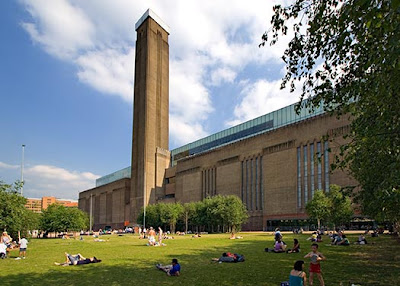 The Tate Modern has put together an extensive and significant exhibition of modern and Avant-Garde art with the aim of exploring the actual process of creating art. There is a fair amount of shocking, violent and graphic artwork in the exhibition so I would say that it is not for the fainthearted. In a nutshell we are made to understand that the making of a work of art is as important as the final product. International artists such as Hockney, Niki de Saint Phalle, Helena Almeida and Edward Krasinsky, who were all working in the 1950’s to 1980’s, all feature in this daring and explosive expose, to name a few.
 As you enter the exhibition there are two pivotal works by Pollock and Hockney. Standing proud is a beautiful Hockney piece, from which the exhibition takes its name. ‘A Bigger Splash’ is a large, luminous painting of a swimming pool in Los Angeles where as an onlooker you can almost feel the heat of the scene. Hockney’s actual splash is created by the layering of white acrylic over many thin washes. He said of this painting: “When you photograph a splash you’re freeing a moment and it becomes something else. I realise that a splash can never be seen in this way in real life, it happens too quickly. And I was amused by this so I painted it in a very slow way” The different blues he uses and the palm trees that frame the painting don’t deter from the central subject – that of the splash. Alongside this is a film of Pollock at work in this studio produced by Hans Namuth and Paul Fallenberg, whose photos of Pollock held such a pivotal role in establishing his reputation. Placed in front of the film cleverly is the finished art work itself. One critic describes Pollock’s work in this way : “We see how Pollock in his dance of dripping, slashing, squeezing, daubing and whatever else went into a work placed an almost absolute value upon a diaristic grandeur.” The artist and what he does whilst creating his work of art becomes an integral part of the painting.
 Another artist who liked to play with notions of paint and creation was Yves Klein. Famous for his blue art works Klein made a film in 1960 called ‘The Anthropometry of Blue Era’ whereby female nudes were covered in blue paint and employed as ‘living brushes’ to make an imprint on canvases. In this rather dramatic and graphic film one notices how weirdly devoid of sexuality and femininity the models become. The art work seems to become more and more violent and thought provoking as you go through the exhibition. ‘3rd Action’ by Rudolf Schwarzkogler, for example, shows evocative black and white photos of clinical scenes such as gutting fish and bound body parts. Like with Saint Phalle there is a strong suggestion of violence, instability and painful psychology. Likewise the gory pictures of nudes on top of each other by Herman Nizsch, called ‘The Festival of Psycho’ is another rather violent portrayal of the creative process. One wonders here though how this can connect to the Pollock and Hockney works at the beginning of the exhibition. It seems rather tenuous.


I was very much drawn to Niki de Saint Phalle’s work as she is one of my favourite modern artists. In the exhibition we see a thirty second film of her in a white bodysuit and her partner Jean Tinguely, entitled ‘The Least Effort’. Both artists are shooting red paint, presumably to represent blood, at one of her installation works. As such, the creative process of making the work of art is what is firing both artist’s imagination. The violence and destructiveness of abstract art is scrutinised and next to the film is a plaster, paint, polythene work of the finished product, called ‘Shooting Picture’. To further explore their creativity Tinguely and Saint Phalle would often invite critics and artists to shoot at their constructions in their studios, releasing the paint that was layered beneath it.

Themes of identity, feminism and beauty and gender are explored by artists like Helena Almeida and the installation artist Karen Kilimnik. In the room featuring the abstract artist Edward Krasinki we see how twelve mirrors are suspended from the ceiling with a single blue tape across each one of them. There is the feeling that space is receding and advancing and is not fixed and the viewer is drawn into reflected images of himself. In Jutta Kroether’s work we see a large, evocative painting suspended and notebooks where people who were invited to view the painting wrote down their thoughts and emotions. In this sense the notebooks became as important as the painting itself and we see the real, whole process of painting unravelling in front of us.
To be honest I did not know what to make of this exhibition finding some of the more graphic and violent art works unappealing and shocking. The message of the artists as a group is not always clear and in fact I left the room feeling overloaded with information. Perhaps this is the type of exhibition that merits a second or even third viewing before the concept of its subject can really be understood as a whole.
By Larissa Woolf, Arts Editor, VisitMuseums.com
Monday, 19 November 2012
Visit Museums and Exhibitions: The Pinacotheque Museum, Paris
Visit Museums and Exhibitions: The Pinacotheque Museum, Paris: The Pinacotheque Museum, Paris The Pinacotheque Museum is in the heart of Paris, in the elegant Place de la Madeleine, and is one of the ...
The Pinacotheque Museum, Paris
The Pinacotheque Museum, Paris
 The Museum’s own collection is normally housed on the lower ground floor and is made up of long term loans from private collectors. Restellini has advocated an unusual and never-done-before philosophy of assembling the paintings and sculptures in no particular school or period. In this sense, for example, a painting by the illustrious Renaissance painter Domenico Ghirlandaio (1449-94) is placed alongside the twentieth century French artist Gaston Chaissac (1910 –64) Similarly a piece by Eugene Delacroix (1826) is neighbours with a painting by Theodore Gericault (1791-1824) The aim of this modern and rather audacious idea is to bring out each painting’s individuality and radiance. The comparison between each painting or set of paintings becomes very rich and exciting. Restellini’s self proclaimed aim is to try to evoke the same magic a work of art has in a private home as in the Pinacotheque.
 There are many masterpieces and works of art to admire. One of my favourite paintings in this collection is by Pieter de Hooch, the renowned genre painter of the Dutch Golden Age, 1629-1684. He was a contemporary of Jan Vermeer whose themes and styles he adopted in his work. The painting on display called ‘A Man reading a letter to his wife’ is one of his most famous and reveals his clever and delicate mastery of light, colour and perspective . He was renowned for choosing intimate family scenes and tableaux. The Modigliani painting that is exhibited is also incredible. Called ‘Hanka Zborowska’ it leapt out at me both because of the intensity of the colours he used and the force of his sitter’s gaze. Modigliani, we learn, was an Italian painter and sculptor who worked and lived mainly in France. He was primarily a figurative artist who worked in a modern style and became famous for his mask like faces and elongation of form just like this Hanka painting.
 Another glorious painting on display is by Renoir and is entitled ‘Portrait of Georgette–Marie Malivernet ’. This is a side profile of a young lady, her head bending low in peaceful contemplation. The warm pastel colours are in tune with the feeling of serenity the painting conveys.
The Pinacotheque Museum is in the heart of Paris, in the elegant Place de la Madeleine, and is one of the capital’s newest museums. It has been directed by Marc Restellini since 2007 – a daring and inspiring curator who has welcomed diverse and interesting exhibitions as well as secured some of the most amazing masterpieces in the world to put on show.


I would have to warn any potential visitor that the room housing the permanent collection is a little claustrophobic and the lighting is poor. Many people have complained of long queues to get into the museum so it is advisable to buy a ticket before hand. Yet notwithstanding this the quality of the exhibitions that are on show and the calibre of the pieces on display in the permanent collection make The Pinacotheque an imperative museum to visit.
By Larissa Woolf, Arts Editor, VisitMuseums.com
Find Hotels in Paris for your visit.
Saturday, 17 November 2012
Visit Museums and Exhibitions: Van Gogh – Dreaming of Japan – Pinacotheque Museum...
Visit Museums and Exhibitions: Van Gogh – Dreaming of Japan – Pinacotheque Museum...: Van Gogh – Dreaming of Japan – Pinacotheque Museum in Paris, 3rd October 2012 to 17th March 2013 The Pinacotheque museum in the heart ...
Van Gogh – Dreaming of Japan – Pinacotheque Museum in Paris
Van Gogh – Dreaming of Japan – Pinacotheque Museum in Paris, 3rd October 2012 to 17th March 2013
 The Pinacotheque museum in the heart of the Madeleine district in Paris is hosting a retrospective of the renowned artist Van Gogh. Forty works, mainly landscapes, are on show and are devoted exclusively to this Dutch great master of Post-Impressionism. Moreover, as the title of the show reveals, the exhibition simultaneously depicts the works of the famous Japanese artist, Hiroshige, alongside Van Gogh, and daringly exposes the profound influence he had on the Dutch painter. The importance of Japanese art and philosophy in the Impressionist era becomes the central subject of the exhibition whilst also showing a significant number of Van Gogh’s evocative and stunning paintings – some of which I certainly have never seen before.
 Vincent Van Gogh was born in Holland in 1853 and his artistic career is marked by his legendary tortured personality and fragile psychology. Whether he was suffering from bi-polar disorder, schizophrenia or some kind of psychological disorder, we see how strongly it affected his view of the world and his artistic output. In comparison Hiroshige conveys a different psychology – one of inner peace, serenity, calm within nature and solidity. We see how the majority of Van Gogh’s landscapes in the exhibition are constructed around a referential system at the centre of which is Hiroshige’s world vision. By almost each Van Gogh painting is placed a corresponding Hiroshige painting and the similarities between the two are marked. Van Gogh discovered Japan in a Parisian prints seller and it had a dramatic effect on him; soon all that corresponded to Japan became a haven for him. In his painting Oliveraie, painted in June 1889, we see hundreds of trees in an olive grove in the South of France. The combination of yellows, greens and blues make for an astoundingly beautiful and luminous picture. The rough beauty of the painting and its emotional intensity is astounding. The corresponding Hiroshige print next to it portrays how closely Van Gogh based this painting on the Japanese artist.


In Van Gogh’s painting Tree Trunks in the grass, one of my favourite paintings in the exhibtion, there is an immensely intense quality to the painting yet all we can see in the picture is tree trunks and flowering grass. The zig zag of the tree trunks and their form and shape are resolent of Japanese art. Van Gogh thus transformed all the paintings he was painting during that part of his life into celebrations of nature based on Japanese principles of form and style. He wanted to find in the South of France a reflection of Japan. In his painting Cyprus and two silhouettes we see how the women look very Japanese and are wearing what looks to be traditional Japanese dress. The swirls of paint and rich colours of the composition combine to create an amazing masterpiece of light, form and colour. In many ways Van Gogh was searching for the inner peace in his paintings that alluded him in real life. The symbiosis of the works and nature, colour and beauty, the trees and the sky combine to create amazing masterpieces.
The number and variety of Van Gogh and Hiroshige’s paintings on show is incredible. The expose becomes a moving testament to the demons in Van Gogh’s soul and his attempt to squash them and create for himself a peaceful and serene life which, sadly, he never ultimately achieved. Perhaps the only problem to be aware of before going to the museum is that there are no english translations of the factual commentaries and no audioguides. If you are not familiar with french this might present a problem to you however the paintings are so beautiful and mesmerising that they merit seeing in their own right.
As always with a Van Gogh exhibition one leaves the show feeling a sense of sadness that such a great artist died so young. He was only 37 when he died after years of mental illness from a self inflicted gun wound. He had far reaching influence on 20th century art.
By Larissa Woolf, Arts Editor, VisitMuseums.com
Find Hotels in Paris for your visit.
Friday, 16 November 2012
Visit Museums iPhone App
Visit Museums and Exhibitions: Visit Museums iPhone App: Visit Museums has recently published an App for iPhone. This is a great way of finding great Museums, Private Galleries and Art Exhibiti...
Subscribe to:
Posts (Atom)